
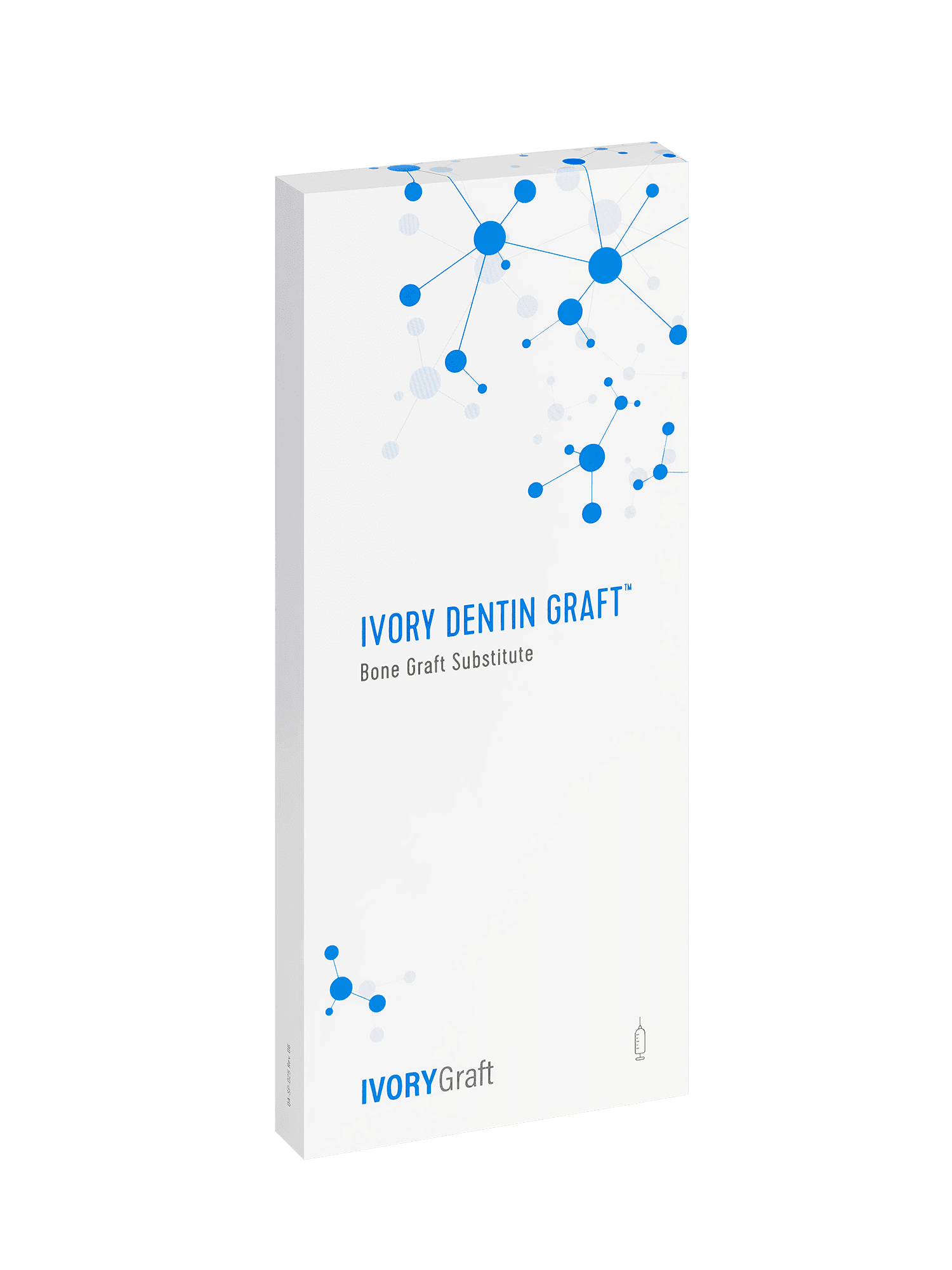
Ivory Dentin Graft, syringe applicator
Coming soon. Price on request.
Resorbable dentine-derived xenograft for guided bone regeneration. Granules in a sterile syringe applicator, delivered straight into the defect.
Pack size
We are finalising supply terms. Join the priority access list to receive them first.
Specifications
- Pack size
- 0.5 g; 1 g
- Presentation
- Granules in a syringe applicator
- Sterilisation
- Gamma-irradiated, single use
- Device class
- Class III, EU MDR 2017/745
Description
Ivory Dentin Graft™ is a resorbable dentine-derived xenograft for rebuilding bone in patients with varying degrees of atrophy. Its structure is close to the mineralised matrix of human bone; the manufacturer states both osteoconductive and osteoinductive properties.
Indications: implant placement, extraction socket preservation, sinus floor elevation, guided bone and tissue regeneration (GBR/GTR), peri-implant and intrabony periodontal defects, defects following root resection, apicoectomy and cystectomy.
Presentation: granules in a sterile syringe applicator sealed in an aluminium pouch, inside a single-use carton. Gamma-irradiated, for single use only.
Amounts recommended by the manufacturer
| Intrabony periodontal defects | 0.25–1 g |
|---|---|
| Defects after root resection, apicoectomy, cystectomy | 0.25–1 g |
| Extraction socket preservation | 0.5–2 g |
| Guided regeneration (GBR/GTR) and peri-implant defects | 0.25–1.5 g |
| Maxillary sinus floor elevation | 2–5 g |
The amount is chosen case by case: patient age, bone quality and density, defect morphology and size, use of barrier membranes and the surgical technique all affect it. The figures above are the manufacturer's general guidance for typical scenarios.
Class III under EU MDR 2017/745. Manufactured by Ivory Graft Ltd., Israel. ISO 13485 quality management system, CE marking.
Material
Dentine is more than a mineral
The material has three components. The inorganic part gives strength, the organic matrix gives biological activity.
| Component | Share | Role |
|---|---|---|
| Hydroxyapatite | 65–70 % | Mineral phase. Provides strength and volume. |
| Type I collagen | ~30 % | The same protein structure found in human bone, with growth factors embedded in the matrix: BMP, TGF-β, IGF, PDGF, FGF |
| Water | 10 % | Bound phase of the matrix. |
| Particle size | 300–900 micrometres |
|---|---|
| Hardness | 73 HV Vickers |
| Ca : PO₄ | 1.59–1.67 ratio |
| Shelf life | 5 years at +5…+30 °C |
| Macropores > 100 µm | Vessel ingrowth and osteoblast migration into the material — vascularisation of the augmented site. |
| Micropores < 10 µm | Plasma protein adsorption and the onset of osseointegration. A diameter of 0.7–1.5 µm gives maximum contact with biological molecules. |
Mechanism
How the material behaves in the defect
Four stages, from application to the end of remodelling.
1
Application and hydration
The material is hydrated with saline immediately before placement. No prior preparation is required.
2
Ankylosis and volume stability
Union with the jawbone. Graft volume is held throughout remodelling.
3
Vascularisation
Vessels grow in through the macropores. BMP and TGF-β recruit osteoblasts to the defect.
4
Parallel remodelling
Resorption keeps pace with osteogenesis: the material neither resorbs early nor stays as an inert body.
Literature
Publications on dentine-derived materials
References for further reading. Study conclusions are not reproduced here.
Cells 2024, 13:1806
Review of 89 publications · properties of bone graft materials
Sánchez-Labrador et al., 2020
Prospective RCT · alveolar ridge augmentation
Oguić et al., 2023
Prospective RCT · aesthetic zone
Mahendra et al., 2024
PRISMA systematic review · ridge augmentation
Safety
Source, processing, sterilisation
The manufacturing site is inspected regularly by international and local regulatory bodies.
- Source material
- Porcine teeth from an isolated colony under veterinary supervision, with systematic analysis of feed, water and animal health.
- Viral safety
- Chemical processing steps are validated to ISO 22442 for the removal of viral contamination. ICP-MS confirmed no heavy metals at toxicologically relevant concentrations.
- Gamma sterilisation
- Final sterilisation of the packaged material by cobalt-60 irradiation. Bioburden of at most 220 CFU per device.
- Storage
- 5 years from the date of sterilisation at +5…+30 °C, away from direct sunlight. The packaging is sealed until opening and every batch undergoes final quality control.
- Regulatory status
- CE MDR 2017/745 · ISO 13485 · ISO 22442 · ISO 9001
Contraindications
Absolute
- Acute inflammation at the surgical site
- Immunological disorders
Relative
- Uncontrolled diabetes mellitus
- Chemotherapy or radiotherapy within the last 5 years
Class III medical device under EU MDR 2017/745, for use by a clinician. This information is intended for professionals and does not replace the instructions for use.
You Are Also Watched
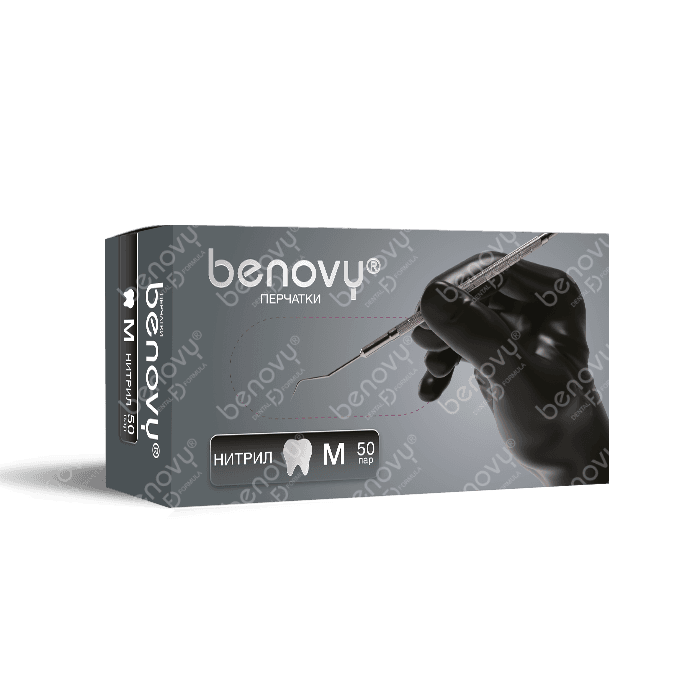
Benovy black nitrile examination gloves — durable, hypoallergenic, powder-free. Sizes S / M / L.
₽400
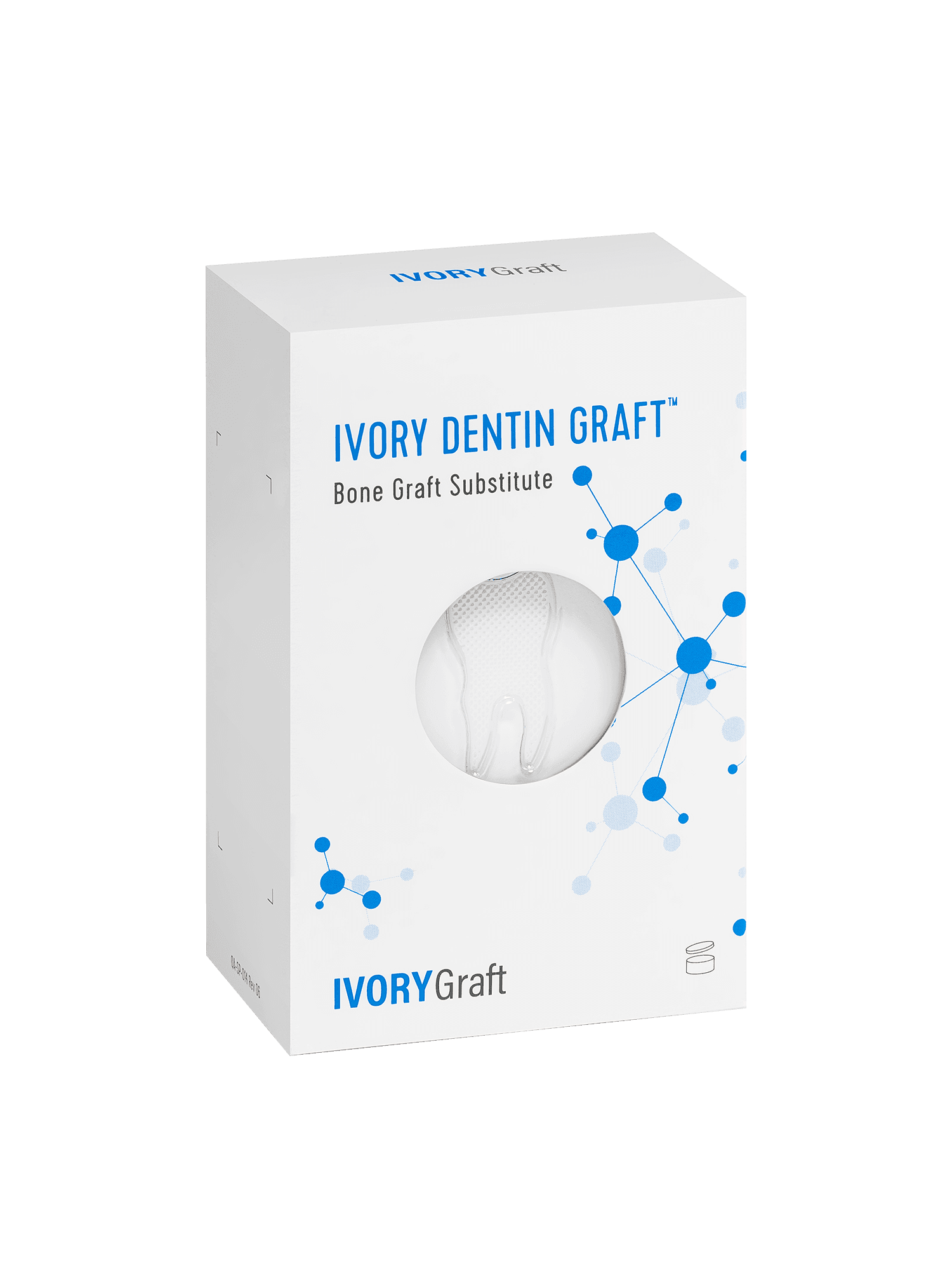
Resorbable dentine-derived xenograft for guided bone regeneration. Granules in a sterile capped glass vial inside an outer blister.
Price on request · coming soon
Join the priority list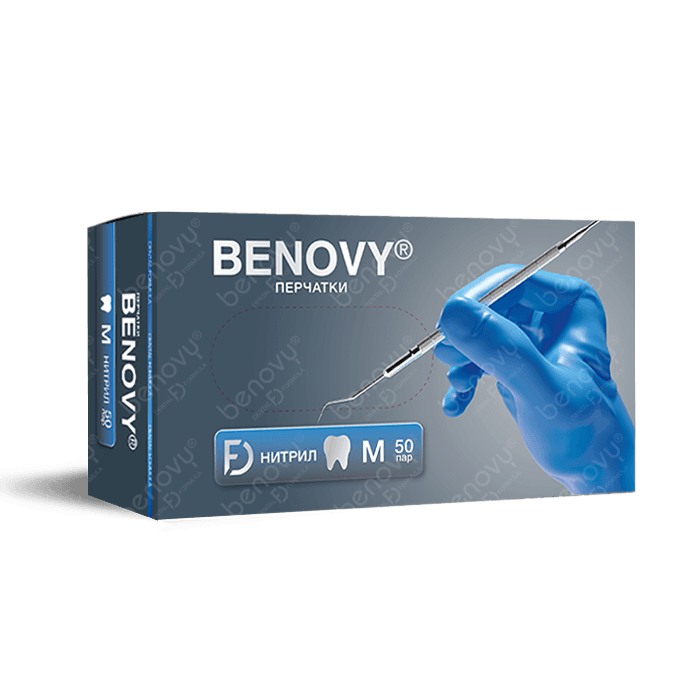
Benovy blue nitrile examination gloves — durable, hypoallergenic, powder-free. Sizes S / M / L.
₽400